Bank Run
Trust, panic, and liquidity pressure in a live classroom bank run.
IntroConverting game theory into practice: A risk-free sandbox where aspiring leaders become active decision-makers in Supply Chain, Finance, and Strategy.
Business Strategy Foundation
Real-world elasticity and cost models at scale.
Zero install, automated assessment, live monitoring.
A 3-step process to mastering business dynamics.
Every round, teams manage 5 key categories with deep interdependencies.
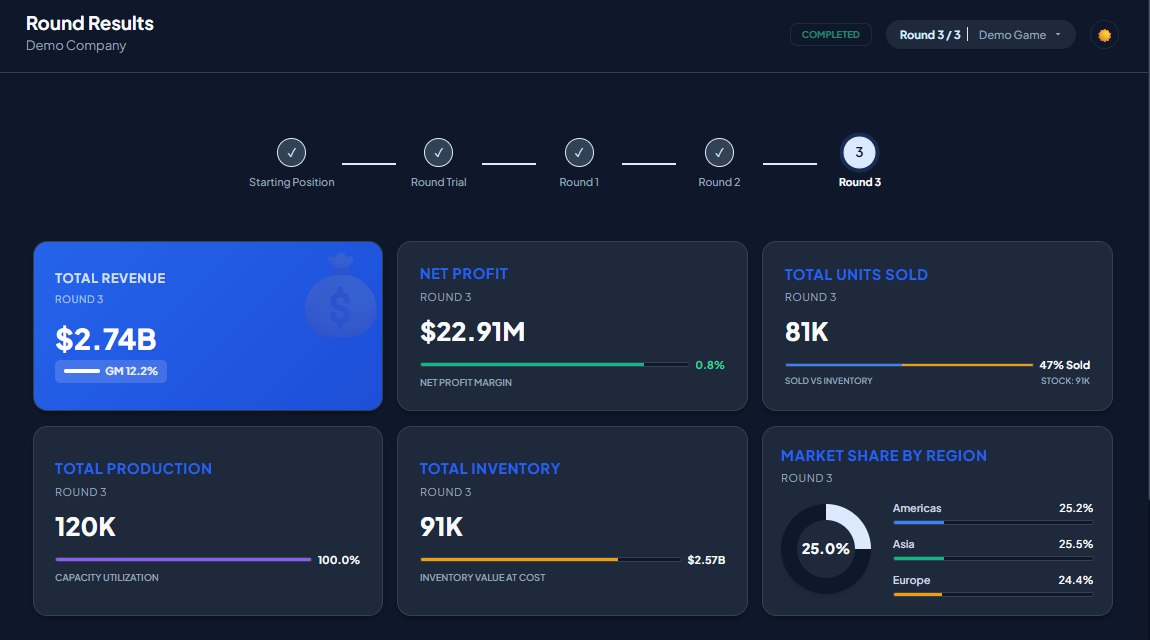
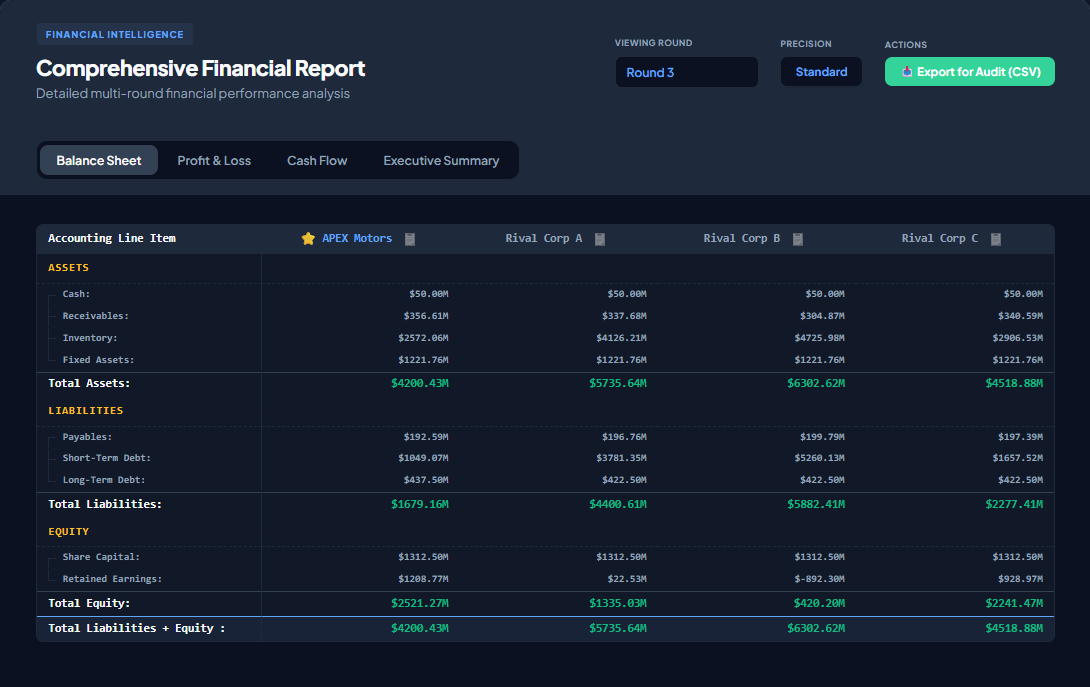
GAAP-compliant financials teach students that Profit ≠ Cash and Leverage is a double-edged sword.
Designed for rigorous analysis without classroom complexity.
Designed in consultation with university educators and iteratively refined through early demonstrations.
Ready-to-launch Classroom Experiments with live host controls, join links, and instant classroom engagement.
Trust, panic, and liquidity pressure in a live classroom bank run.
IntroPersonal finance choices across rounds with delayed credit impact.
IntroClassic cooperation vs. self-interest under repeated strategic play.
IntroFairness, bargaining power, and acceptance thresholds in action.
IntroCommon-pool resource decisions between short-term gain and sustainability.
Intro-IntermediateReciprocity and trust formation when returns depend on others.
Intro-IntermediateFree-rider pressure and contribution strategy in shared outcomes.
Intro-IntermediateReal-time buyer-seller bids reveal market-clearing price dynamics.
IntermediateZero-sum strategic randomness and mixed-strategy equilibrium.
IntermediateQuantity-setting competition in oligopoly markets.
IntermediatePrice competition dynamics and margin pressure under rivalry.
IntermediateAscending-bid behavior, valuation gaps, and bidding discipline.
IntermediateAnd more experiments available in the catalog across Intro, Intro-Intermediate, and Intermediate levels.
All concepts integrated in a single competitive environment

Proudly supporting MathX.nz — free, open-source maths for every student.
"I like that outcomes can be unexpected. It creates better classroom discussion than traditional cases, where students just repeat the same frameworks."
"This feels much closer to how real managers think. There isn't an obvious right answer, which forces students to explain and defend their decisions."
"The financial statements help students connect strategy with numbers in a way spreadsheets alone never quite achieve."
| Traditional Case Studies | AI Decision Lab | |
|---|---|---|
| Learning Mode | Static, retrospective analysis | Interactive, forward-looking decisions |
| Student Role | Analyst of past events | Decision-maker under uncertainty |
| Financial Depth | Simplified or partial financials | Integrated financial statements across rounds |
| Assessment Effort | Manual review of written submissions | Structured outputs support scalable assessment |
| Feedback Timing | Delayed, instructor-dependent | Immediate, in-round feedback and reflection |
The first business simulation that teaches strategy through real competition, not just theory.
$100 Million. 1 monopoly.
Real-time market shifts. Can you dominate?
A brutal economic simulation • No luck • Pure strategy
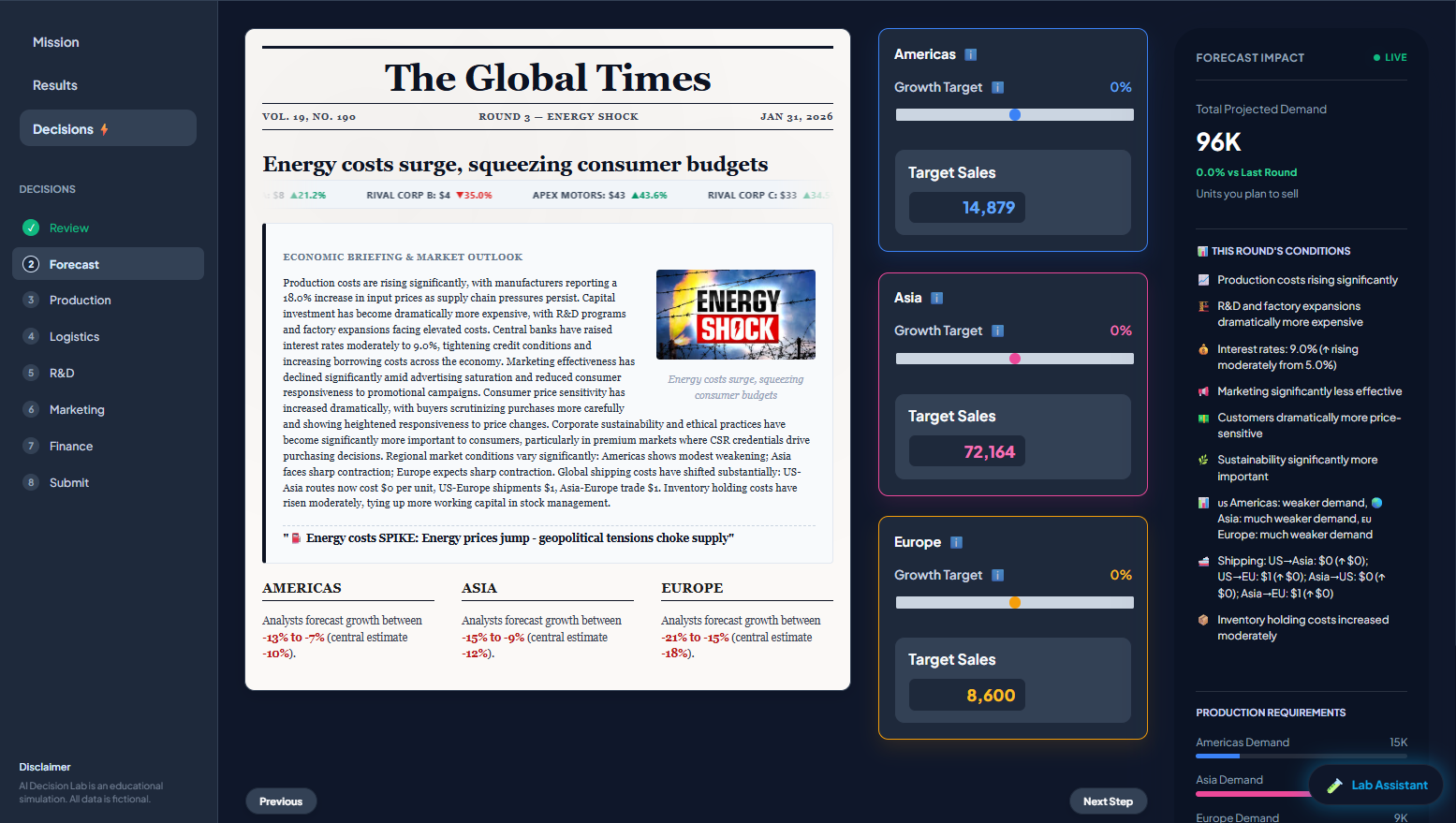
Set realistic growth expectations. Your forecast impacts inventory planning, cash flow, and factory capacity decisions.
Set your production volume. Higher volume improves unit economics through scale, but pushing beyond 80% capacity triggers overtime and inefficiency costs. Balance growth ambitions with operational reality.
Price elasticity is real. Set prices too high and demand evaporates. Too low and you're leaving margin on the table. Marketing budget drives market attractiveness.
Combines price positioning, promotion reach, and product quality scores.
You can't fulfill all demand. Set market priorities to determine which regions get orders first. When inventory runs low, lower-priority markets miss out.
Produce locally to bypass international shipping tariffs.
Invest in research to unlock premium features. More staff + advanced training = faster innovation. Innovation commands premium pricing but requires capital investment.
Borrow to accelerate growth or return cash to shareholders. Your debt/equity mix and dividend policy signal confidence to the market. Each impacts your stock price.
The other teams are already moving.
Markets are shifting. Time is not on your side.
A deep strategic business simulation • Real economics