The Modern Classroom OS

Bridging the
Classroom Gap.

Converting game theory into practice: A risk-free sandbox where aspiring leaders become active decision-makers in Supply Chain, Finance, and Strategy.

75% Retention via Doing
< 10% Lecture Retention Standard

Market Competition Dynamics

Business Strategy Foundation

GEN: 0
Tit-For-Tat 0
Cheater 0
Cooperator 0
TFT
Cheater
Coop

Simulation Mechanics

Real-world elasticity and cost models at scale.

Educator Tools

Zero install, automated assessment, live monitoring.

Skills Mastery

Financial Statement Analysis Decision-Making Under Uncertainty Strategic Trade-Off Analysis Collaborative Problem Solving Game Theory
Trusted By
Scroll to Discover

Learn Strategy Through Competition, Not Memorization

A 3-step process to mastering business dynamics.

Step 1

Students Make Strategic Decisions

Every round, teams manage 5 key categories with deep interdependencies.
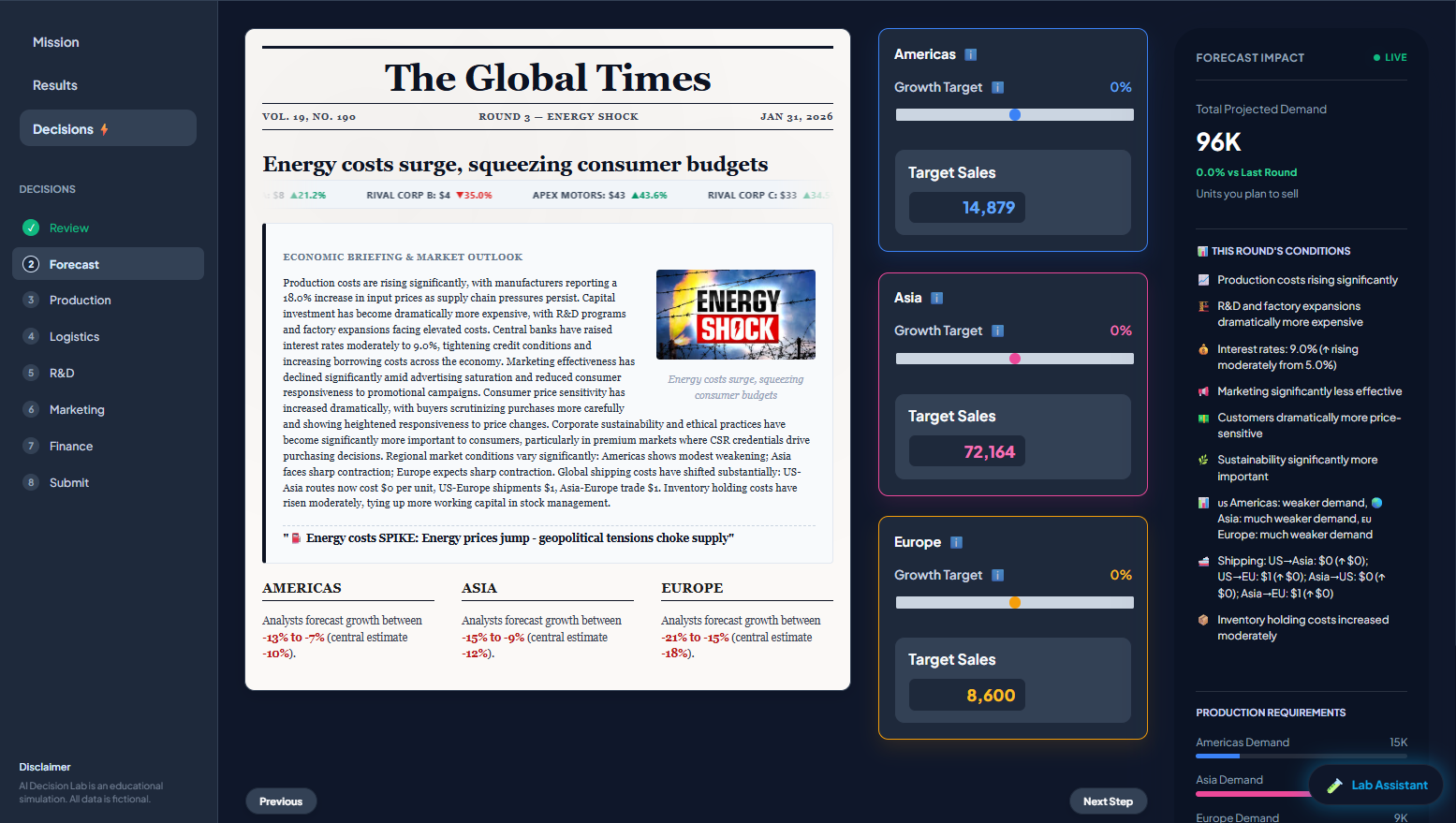
πŸ’° Pricing & Marketing
🏭 Production & Ops
πŸ”¬ R&D & Innovation
πŸ’Ό Finance & Capital
Decision interface
Step 2

The Market Judges Them

  • 1
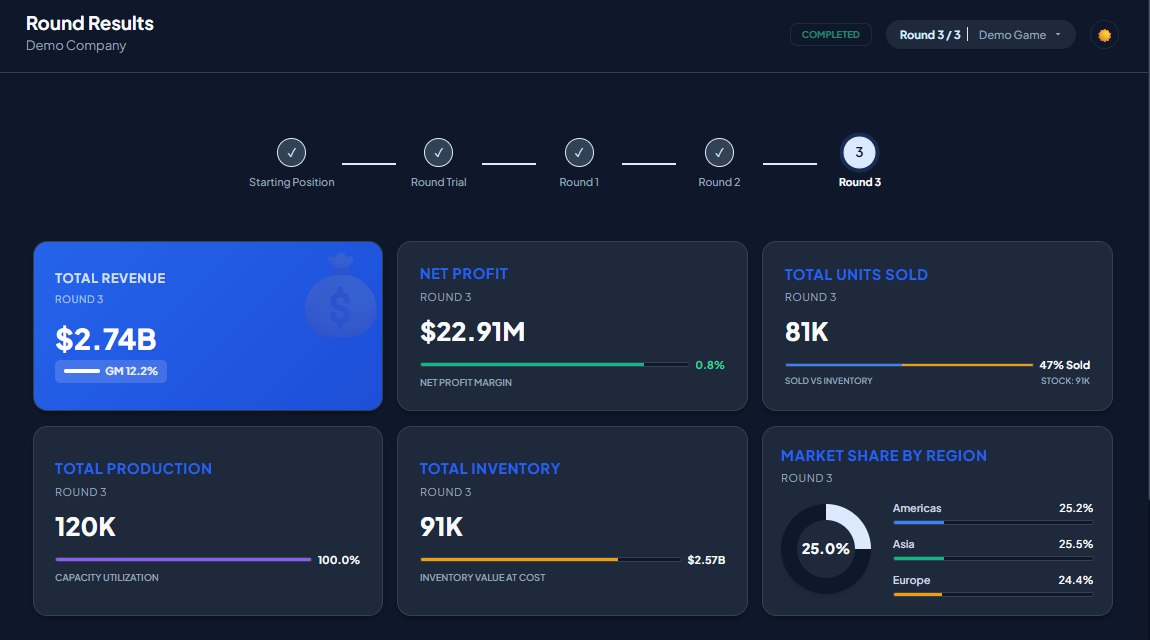
    Game-Theoretic Competition: Market share is calculated using weighted attractiveness models.
  • 2
    Strategic Interdependence: Price too high? Competitors steal your customers.
  • 3
    Capacity Constraints: Run out of inventory? Competitors capture your unmet demand.
Market share results
Step 3

Real Financial Consequences

GAAP-compliant financials teach students that Profit β‰  Cash and Leverage is a double-edged sword.
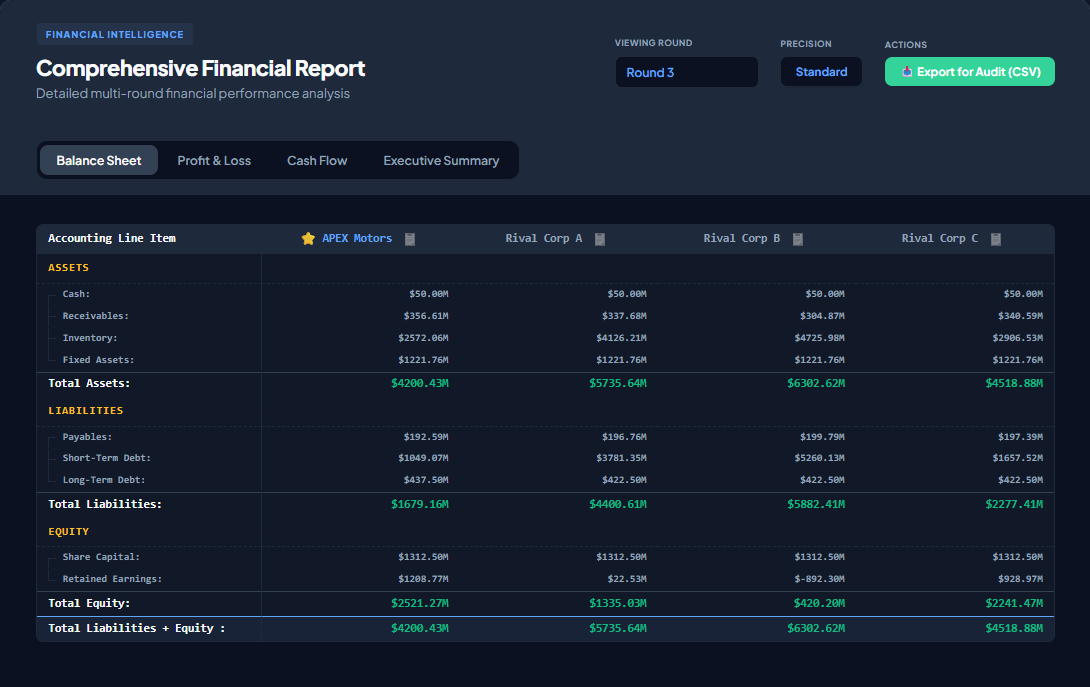
Income Statement
Balance Sheet (A = L + E)
Statement of Cash Flows
Financial statements

Built for Serious Business Education

Designed for rigorous analysis without classroom complexity.

Intelligent Simulation Design

  • Dynamic scenario generation: Macro-economic shocks (e.g. demand cycles, cost volatility, policy constraints) introduce uncertainty across rounds.
  • Adaptive competitor behavior: Algorithmic firms maintain competitive pressure across different class sizes.
  • In-round feedback cues: AI-assisted insights support student reflection and decision review.

Academic Rigor & Flexibility

  • Highly configurable model: Extensive parameters allow instructors to adjust demand sensitivity, cost structures, and strategic weights.
  • Game-theoretic foundations: Oligopolistic market dynamics inspired by Cournot and Bertrand competition.
  • Learning outcomes support: Structured outputs designed to align with assurance-of-learning and accreditation processes.

Teaching Efficiency at Scale

  • Reduced grading overhead: Quantitative outputs and decision logs support scalable assessment.
  • Low setup friction: Web-based access with pre-configured teaching materials.
  • Rapid onboarding: Instructors can configure and launch a game within a short setup window.

Professional-Grade Outputs

  • Integrated financial statements: Income statement, balance sheet, and cash flow generated each round.
  • Research-ready data exports: Granular round-level data available for analysis, comparison, and classroom research.

Designed in consultation with university educators and iteratively refined through early demonstrations.

Classroom Experiments

Ready-to-launch Classroom Experiments with live host controls, join links, and instant classroom engagement.

Bank Run

Trust, panic, and liquidity pressure in a live classroom bank run.

Intro

Credit Score

Personal finance choices across rounds with delayed credit impact.

Intro
3/3 0/5 5/0 1/1

Prisoner's Dilemma

Classic cooperation vs. self-interest under repeated strategic play.

Intro
70% 30%

Ultimatum Game

Fairness, bargaining power, and acceptance thresholds in action.

Intro

Fishery Commons

Common-pool resource decisions between short-term gain and sustainability.

Intro-Intermediate

Trust Game

Reciprocity and trust formation when returns depend on others.

Intro-Intermediate

Public Goods Game

Free-rider pressure and contribution strategy in shared outcomes.

Intro-Intermediate

Double Auction

Real-time buyer-seller bids reveal market-clearing price dynamics.

Intermediate
No pure NE

Matching Pennies

Zero-sum strategic randomness and mixed-strategy equilibrium.

Intermediate
NE

Cournot Competition

Quantity-setting competition in oligopoly markets.

Intermediate

Bertrand Competition

Price competition dynamics and margin pressure under rivalry.

Intermediate

English Auction

Ascending-bid behavior, valuation gaps, and bidding discipline.

Intermediate

And more experiments available in the catalog across Intro, Intro-Intermediate, and Intermediate levels.

One Simulation. Multiple Business Disciplines.

All concepts integrated in a single competitive environment

E

Economics

  • β€’ Oligopolistic competition and strategic interdependence
  • β€’ Diminishing returns to R&D investment
  • β€’ Price elasticity and demand sensitivity
  • β€’ Macro-level demand and cost shocks
F

Finance & Accounting

  • β€’ Accrual-based revenue and expense recognition
  • β€’ Financial ratio interpretation
  • β€’ Capital structure trade-offs (debt vs equity)
  • β€’ Payout decisions and signaling intuition
S

Strategy

  • β€’ Generic competitive strategies
  • β€’ Positioning and differentiation trade-offs
  • β€’ Timing decisions in R&D and market entry
  • β€’ Integrated scenario-based decision-making
O

Operations

  • β€’ Capacity planning and utilization decisions
  • β€’ Inventory and holding cost trade-offs
  • β€’ Supply chain considerations and Corporate Social Responsibility (CSR) constraints
  • β€’ Make-or-buy decision logic
MathX.nz logo

Proudly supporting MathX.nz — free, open-source maths for every student.

Early Educator Feedback

"I like that outcomes can be unexpected. It creates better classroom discussion than traditional cases, where students just repeat the same frameworks."

"This feels much closer to how real managers think. There isn't an obvious right answer, which forces students to explain and defend their decisions."

"The financial statements help students connect strategy with numbers in a way spreadsheets alone never quite achieve."

How AI Decision Lab Complements Traditional Case Studies

Traditional Case Studies AI Decision Lab
Learning Mode Static, retrospective analysis Interactive, forward-looking decisions
Student Role Analyst of past events Decision-maker under uncertainty
Financial Depth Simplified or partial financials Integrated financial statements across rounds
Assessment Effort Manual review of written submissions Structured outputs support scalable assessment
Feedback Timing Delayed, instructor-dependent Immediate, in-round feedback and reflection

Ready to Transform Your Course?

The first business simulation that teaches strategy through real competition, not just theory.

TAKE THE THRONE:CEO REQUIRED

THE CHAIR
IS VACANT

$100 Million. 1 monopoly.
Real-time market shifts. Can you dominate?

A brutal economic simulation β€’ No luck β€’ Pure strategy

Scroll for Briefing
1

What's Your Growth Target? πŸ“ˆ

Set realistic growth expectations. Your forecast impacts inventory planning, cash flow, and factory capacity decisions.

Quarterly Growth Target 12%
Range: 5% - 40% growth
Total Projected Demand
90k units
↑ +8% vs last quarter
Total Projected Revenue
$67.5M
At current average selling price
2

How Much Will You Produce? βš™οΈ

Set your production volume. Higher volume improves unit economics through scale, but pushing beyond 80% capacity triggers overtime and inefficiency costs. Balance growth ambitions with operational reality.

🏭
Global Manufacturing Control
Operational Strategy
Primary Supplier Low CSR
Shift Schedule 1 Shift
Production Volume 450k
Max Capacity: 300,000 units
Current Unit Cost
$26.0k
Operational Status
Optimized
Factory Efficiency
50%
Optimal Β· Optimal 80%
Purchase Intent Score
65
Moderate
3

What Price Point Wins Markets? πŸ’°

Price elasticity is real. Set prices too high and demand evaporates. Too low and you're leaving margin on the table. Marketing budget drives market attractiveness.

Regional Strategy
Primary target market for high-margin growth
Market Active
Unit Price $135
Economic ($80) Premium ($250)
Marketing Budget 8%
Maintenance (0%) Aggressive (30%)
Market Purchase Intent
72
Strong

Combines price positioning, promotion reach, and product quality scores.

Estimated Market Revenue
$18.5M
Projected based on North America conversion rate
4

Who Gets Your Limited Supply? πŸ“¦

You can't fulfill all demand. Set market priorities to determine which regions get orders first. When inventory runs low, lower-priority markets miss out.

πŸ’‘
Local Manufacturing Advantage

Produce locally to bypass international shipping tariffs.

Total Products Available
375k
Global Tariffs
$5.2M
Market Priority Order
Drag items to reorder fulfillment priority
America
Est. Demand: 194k
Shipping tariffs
Free
Priority 1
🌏
Asia Pacific
Est. Demand: 690k
Shipping tariffs
$12/unit
Priority 2
πŸ‡ͺπŸ‡Ί
Europe
Est. Demand: 120k
Shipping tariffs
$7/unit
Priority 3
Market Fulfillment Analysis
Market
Shipping
Fulfillment
πŸ‡ΊπŸ‡Έ NA
Free
39%
🌏 AP
$12/u
36%
πŸ‡ͺπŸ‡Ί EU
$7/u
0%
5

How Much Will You Invest in Innovation? πŸ§ͺ

Invest in research to unlock premium features. More staff + advanced training = faster innovation. Innovation commands premium pricing but requires capital investment.

Next Feature Unlock
Full Self Driving πŸš—βœ¨
Unlocking Progress
75%
Research Headcount
Monthly Staff 60
Development Hours 1.2k hrs
Research Overhead $300k
Training Level
Market Purchase Intent
72
Growing
6

Will You Borrow to Grow or Pay Dividends? 🏦

Borrow to accelerate growth or return cash to shareholders. Your debt/equity mix and dividend policy signal confidence to the market. Each impacts your stock price.

Debt Management

Projected Debt / Limit $15.0M / $40.0M
Debt Ratio: 14.6% (Safe < 40%)
New Debt / Repay +$5.0M
Repay $15M Borrow $25M

Shareholder Returns

Dividend Payout $0.0M
Max allowed: $4.1M (50% of profit)
Projected Cash Position
$12.4M
Post-dividend liquidity remains healthy

THE THRONE
AWAITS

The other teams are already moving.
Markets are shifting. Time is not on your side.

A deep strategic business simulation β€’ Real economics